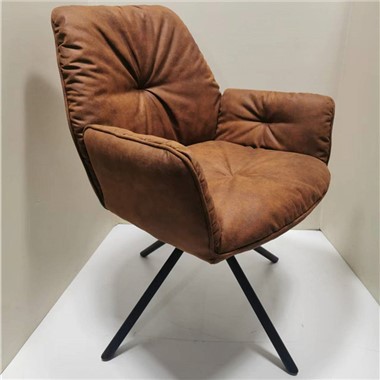
What Is The Size Of The Dining Chair?
Dec 16, 2022
1. Seat height of standard chair size
The seat height refers to the vertical distance from the seat surface to the ground; if the seat surface has a receding or concave arc shape, the seat height refers to the vertical distance from the center point of the front edge of the seat to the ground. If the seat height is too high, the legs will be suspended in the air and will compress the thigh blood vessels; if the seat height is too low, it will cause physical fatigue. Practice has proved that the appropriate seat height is the height from the calf socket to the sole of the foot plus the heel thickness of 25-35mm, and then minus 10-20mm of activity margin. which is:
Seat height H = calf socket height + heel thickness - proper clearance
The national standard GB 3326-1997 stipulates that the seat height H is 400-440mm, and the size difference is 10mm. The maximum height of the soft seat is 460mm (excluding the sinking of the seat). The height of the sofa seat can be lower, so that the legs are stretched forward and the backrest is tilted back, which is conducive to the natural state of the spine. The seat height of the sofa is generally 360-420mm.
2. Seat inclination angle and back inclination angle of chair size standard
The angle between the seat surface and the horizontal plane is called the seat inclination angle α; the angle between the backrest and the horizontal plane is called the back slope angle β.
The national standard GB 3326-1997 stipulates that the seat inclination angle α is 1-4 degrees (back chairs and armchairs), or 3-6 degrees (folding chairs), and the angle difference is 1 degree; the back inclination angle β is 95-100 degrees (back chairs). and armchairs), or 100-110 degrees (folding chairs), with an angle step of 1 degree. For a sofa, α is 3-6 degrees, and β is 98-112 degrees; it is even larger for a recliner.
3. Seat depth of standard chair size
Seat depth refers to the distance from the front edge of the seat surface to the rear edge. If it is too deep or too shallow, it will cause fatigue and discomfort to the calves and lower back. Practice has proved that the seat depth should be slightly smaller than the horizontal length of the thigh when sitting. which is:
Seat depth T = the horizontal length of the thigh in the sitting position exceeds 60mm (gap)
The national standard GB 3326-1997 stipulates that the seat depth T is 340-420mm (back chair), or 400-440mm (armchair), or 340-420mm (folding chair), and the size difference is 10mm. For sofas and other leisure seats, the seat depth can be slightly larger, 480-560mm, due to the large backrest inclination.
4. Seat width of standard chair size
The seat width should be able to fully support the arm and leave room for it. For armchairs, the inner width of the armrest is the seat width, which is generally determined by the average person's shoulder width plus an appropriate margin. which is:
The inner width of the front edge of the handrail B = human body shoulder width + thickness of winter clothes + activity margin
The national standard GB 3326-1997 stipulates that the front width B of the armchair or folding chair seat is greater than or equal to 380mm, and the size difference is 10mm; the inner width B of the front edge of the armrest is greater than or equal to 460mm, and the size difference is 10mm.
5. Backrest height of chair size standard
The minimum height of the backrest of the chair can be set at the first and second lumbar vertebrae (work chair), and the length can be gradually increased, up to the shoulder blade and neck (leisure chair), while static rest can require the length of the backrest to support the head. department (leisure chair). Practice has proved that the best support point of the backrest is about 250mm.
The national standard GB 3326-1997 stipulates that the backrest height L is greater than or equal to 275mm, and the size difference is 10mm.
6. Armrest height of chair size standard
The height of the armrest should be close to the vertical distance from the human body's ischial node to the lower end of the elbow when it sags naturally. Practice has proved that the vertical distance from the upper surface of the handrail to the seat surface is preferably 200-250mm. At the same time, the front end of the armrest should be slightly higher. With the change of the inclination angle of the seat surface and the inclination angle of the backrest, the inclination of the armrest generally has a gradient of 10-20 degrees, and the level difference of the armrest at the left and right side of the level is preferably within the range of 10 degrees.